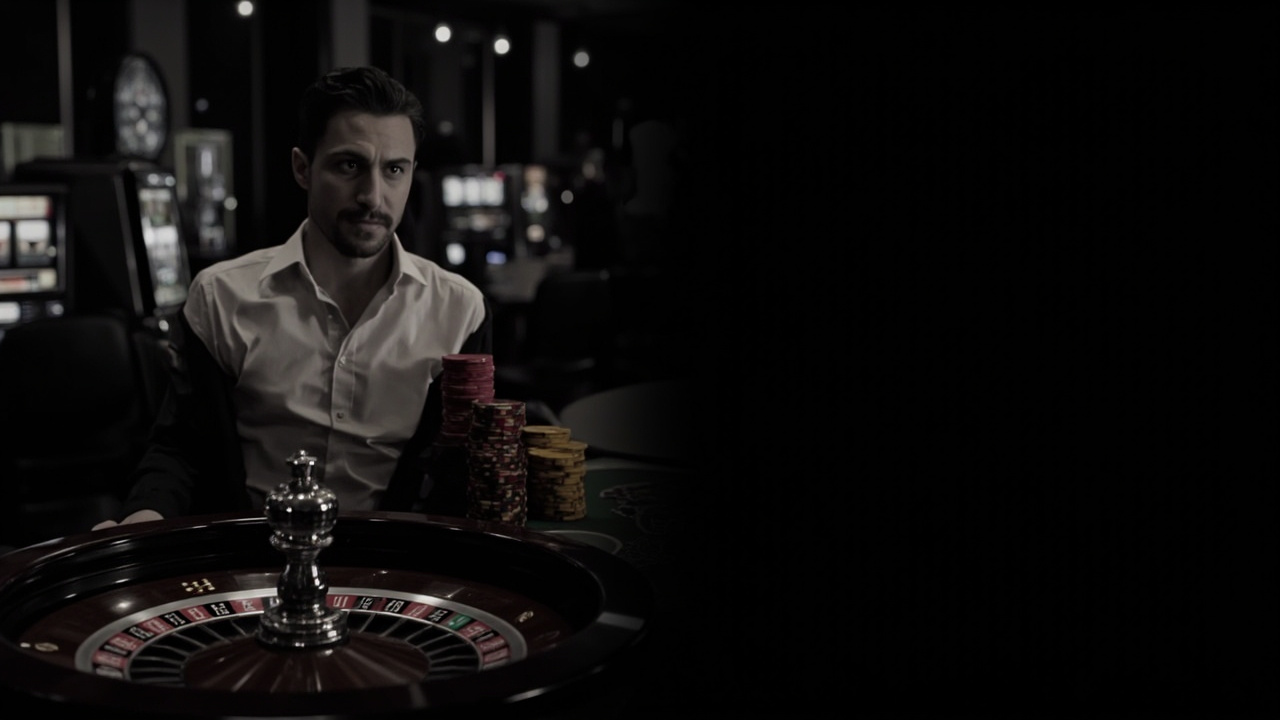
Every American roulette wheel carries a built-in mathematical advantage, and for Australian players betting at online casinos, that edge is the single most important number to understand. The standard 38-pocket American wheel – 18 red, 18 black, 1 and 2 green – delivers a house edge of 5.26% on even-money bets like red, black, odd and even. European and French single-zero wheels sit at 2.70% and 1.35% respectively. That two-and-a-half percentage point gap sounds small until you run it across hundreds of spins.
The Numbers Behind the American Wheel

Work out the edge yourself and it becomes concrete. On a straight-up bet of $10 on a single number, you win $360 if it lands and lose $10 if it doesn’t. Probability of hitting that number is 1 in 38, or 2.63%. Expected return: $360 × 0.0263 = $9.47, against $10 staked. The shortfall is $0.53 per $10 wagered, which is 5.26% of turnover. The green pockets do all the work. Every bet on the table loses to them.
The same maths applies to outside bets, though the stakes differ. A $10 red bet returns $20 on a win. Red covers 18 of 38 pockets, giving 47.37% probability and an expected return of $9.47. Even-money bets and money-back wagers on odds, high and low, columns and dozens all price in at exactly 5.26%. Pair bets (a split, a street, a corner) carry the same house margin, because the payout odds and pocket count never shift the underlying expectancy.
Crucially, no strategy changes it. Martingale, Fibonacci and D’Alembert all move your bet sizing around, but each unit wagered retains the same 5.26% charge, so the more you play, the more the house collects. What changes is variance and, more damagingly, total turnover.
Where the Edge Lives in the Lobby
For players browsing a catalog, the meaningful discovery task is not finding “roulette” in a search bar – it is identifying which wheel variant a table is actually running. A lobby can list twenty roulette titles with wildly different mathematics hidden behind similar thumbnails. A single-zero European table and a double-zero American table can sit two clicks apart, with only a small “European” or “Double Zero” badge distinguishing them.
Site-wide filtering and search quality therefore matter more here than anywhere else in the catalog. If a player cannot filter by wheel type, they are guessing. Some casinos lead with a European table in a promotional banner and quietly bury the double-zero versions under a “more games” tab; others do the reverse, and the reverse is the version worth knowing about.
That is why the catalog’s navigation must be precise and intuitive, giving players confidence that the right wheel is only a few clicks away. A quick check of the lightning link can reveal how well filtering and search options work in practice.

Live dealer studios complicate it further. A live roulette stream can be European, American or French depending on the studio and the individual table’s rules, and the difference is rarely stated in the lobby tile. Providers such as Evolution, Playtech and Pragmatic Play each ship multiple roulette configurations, so the same brand name can hide different edges across tables.
Practical Steps for Reading a Roulette Table
- Identify the wheel layout. Look for a physical wheel image or a rules panel on the table’s info button. Count the pockets: 37 single-zero pockets, or 38 with the double zero. Both a 0 and a 00 means American, and 5.26%.
- Check the table rules on house bets. Some venues add a “half lost on 0” rule or a special insurance-style bet. These change the payout, not the underlying pocket count, so the edge can move slightly from the standard figure.
- Confirm the minimum and maximum stakes. A $0.50 to $5,000 table lets a Martingale run for a long time before the maths catches up with your bankroll.
- Work out your turnover, not just your win rate. Multiply your average bet by the number of spins. That number times 5.26% is your expected cost, and it is the figure that actually predicts your session result.
- Read the roulette bonus terms. A promotional match or rebate on roulette losses may be calculated on turnover rather than net loss, which effectively raises the effective edge above 5.26% if you don’t fully convert the bonus.
What the Edge Means for Real Players
Consider Marco, a 34-year-old Adelaide tradesman who starts a Friday night session with $200 in his account at an online casino’s live roulette table. He bets $5 on red, and after 100 spins he has won $45 and lost $30, netting $15 up. On the surface, a profitable evening. But he staked $500 in total, and the expected cost at 5.26% was $26.30. His $15 win was luck on top of a structural loss. Had he played the same session on a single-zero wheel at 2.70%, the expected cost would have been $13.50 – a materially different outcome from the same bet sequence.
That gap is why players migrating from European tables to American ones often feel the squeeze without knowing why. Bankroll depletion per hour of play roughly doubles. Sessions end sooner. The pattern is familiar: the same “strategy” simply bleeds faster.
The responsible-gambling comparison is uncomfortable. Australian online casinos are licensed and regulated through state and territory frameworks, with deposit limits, self-exclusion and account verification designed to keep play bounded, and none of those tools alter the maths. A $200 loss chasing a Martingale sequence on a 5.26% table is a genuine path to a much larger loss. Reckoning the edge before you sit down is not about willpower; it is about picking the table where your money lasts longest.
For a player who wants to actually win, the roulette lobby is not the place. Rounds with shorter sessions, lower volatility and better published maths will always outperform a roulette grind, and playing only when the bonus terms align with the wheel’s edge is a sensible discipline. But if roulette is the game, the single most useful habit is learning to spot the double zero before you commit a cent.
Where Australian Roulette Tables Sit
Marketplace matters as much as mathematics. Australian players can access offshore operators that are not licensed or regulated in Australia, and the phrase “not licensed in Australia” should be read literally – no local consumer protection applies, no Australian ombudsman can intervene, and any dispute sits with a foreign regulator, if one exists. The domestic licensed operators offer something different: audited game maths, published house rules, deposit limits in AUD, and support that operates in Australian time zones.

Local details shape the experience too. Adelaide players can expect cashier-style bank transfers through local banking rails, though the common rails are cards, e-wallets and bank transfer, with AUD the default display currency and no conversion friction if you hold Australian dollars. Most platforms run a mobile-first lobby with the same catalog on a phone in a Glenelg pub as on a desktop, and the live tables use a low-bandwidth stream that survives hotel and transit connections. Roulette bonuses typically arrive as cashback on net losses or a match on a first deposit, with wagering conditions around 20x to 35x on eligible roulette play.
One casino, Thunderbolt Play, publishes the wheel type on every table tile and offers a 5% cashback on roulette net losses each Monday – a rarer arrangement than the usual match-on-deal, and one that partially offsets the 5.26% rather than amplifying turnover through bonus chasing. Its Australian catalogue spans around 1,900 titles from 40-plus studios, with roulette clearly sectioned into single-zero, double-zero and live dealer tables so the wheel maths is visible before you stake. Thunderbolt Play also runs a loyalty scheme with tiered cashback and a dedicated live dealer floor, and support operates 24/7 in English from a Sydney-based team, which is where a question about “the double zero” can get a straight answer rather than a scripted reply.
One note that trips up even experienced punters: James Bond plays poker in the 2006 “Casino Royale” film – and the film’s blackjack-adjacent gambling sequences are often misremembered as roulette. Bond does not feature in this calculation at all, and anyone who uses a cinematic hunch for wagering is working from fiction.
Weighing the Edge Against the Alternatives
The straight verdict: at 5.26%, American roulette offers Australian players the worst mathematics in the standard table game family, and no staking plan, bonus or loyalty tier changes that. For a beginner or a recreational player, the fit is weak – the edge is high, the variance is wide, and the session-ending loss arrives faster than intuition suggests. For a dedicated roulette enthusiast who wants the genuine atmosphere of a wheel and a live dealer, the fit is conditional rather than negative: choose a single-zero table, set a firm session limit in AUD, and treat any bonus as a constraint on turnover rather than a boost to it.
The practical test is simple and honest. Multiply your average stake by your planned number of spins, then take 5.26% of that total. If the number makes you uncomfortable, the table is wrong – and switching to a European wheel halves it immediately. Know the edge, pick the wheel deliberately, and let the bankroll outlive the strategy.
Related: For how the maths stacks up against other table games, see roulette house edge compared with craps for Australian players.